There’s no shortage of digital marketing agencies. And if you’ve been talking to a few of them lately/looking for a new partner, you’ve probably noticed that they’re all starting to sound pretty similar. Everyone is data-driven. Everyone gets results. Everyone has an AI strategy.
I’ve been in digital marketing for more than 20 years, and I can tell you that a good pitch doesn’t necessarily translate into a good agency relationship. When I was in house, my companies were spending MILLIONS of dollars on ad spend per year with agencies of record that would put a new junior staff member on our ads accounts every 5 months or so.
The industry has changed tremendously, especially over the past couple of years. We’re no longer just talking about Google rankings and paid search campaigns. Businesses now have to think about how they’re showing up in Google’s AI Overviews, ChatGPT, Perplexity, social platforms, and wherever else their customers are looking for information. It’s a lot to keep up with. And it’s not always easy to figure out which agencies really understand these changes and which ones have simply updated their sales presentations. But here’s the thing. While the technology keeps changing, what makes an agency worth hiring really hasn’t.
You still need smart, experienced people who understand your business, know how to spend your money responsibly, and are willing to tell you when something isn’t working. Before we led Simple Search, many of us sat on the other side of the table. We hired agencies. We managed them. We sat in meetings where we had to explain their reports to people who controlled our budgets. Some of those partnerships were great. Some taught us exactly what we never wanted to be. Here’s what the client side taught us, and what we do differently because of it.
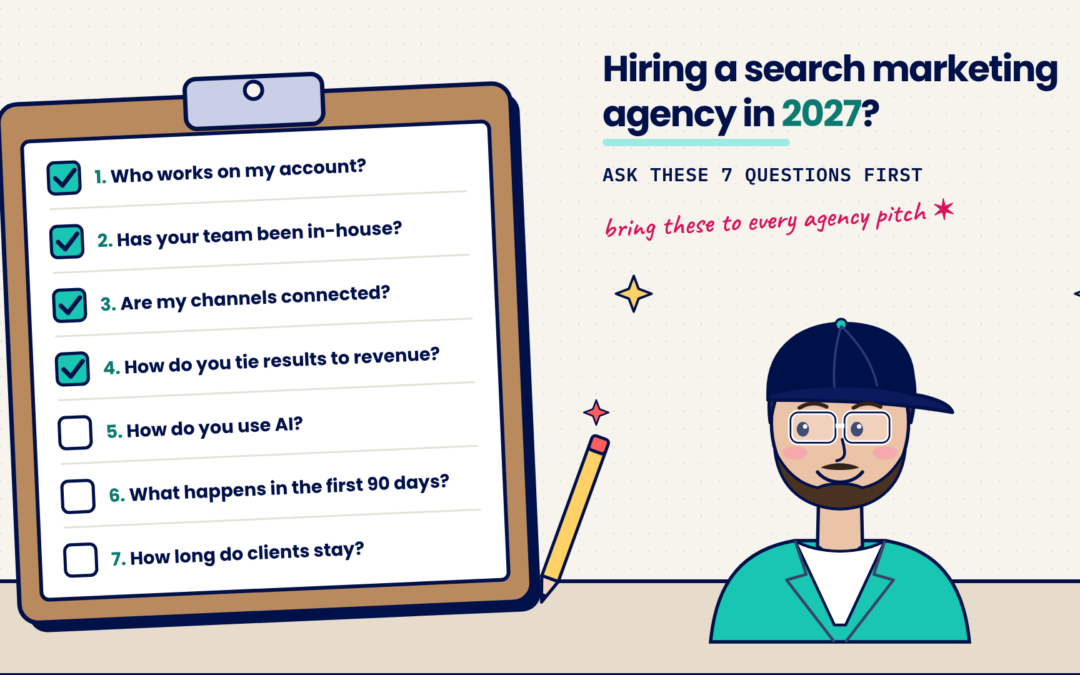
If I were hiring a digital marketing agency in 2027, these are the questions I’d ask.
1. Who’s actually going to be working on my account?
I’d start here. It’s pretty common for agencies to bring their most senior people into a pitch. You meet the founder, maybe a VP or two, and everyone in the room has 15 or 20 years of experience. Then you sign the contract and 3 weeks later, you’re working with someone you never met during the sales or kickoff process, and the people who impressed you in the pitch are nowhere to be found and you may see them once a year if that. That’s not to say junior marketers can’t be great at what they do. Everyone has to start somewhere, and I’ve worked with some incredibly talented people early in their careers, but if you’re paying for senior-level expertise, you should actually be getting it.
I’d ask to meet the people who will be managing my account before signing anything. Not just the account manager, but the people who will be making recommendations, managing campaigns, and deciding where my budget goes. And I’d want to know how involved the senior team will be once the relationship is underway.
2. Has anyone on your team worked in-house?
This one probably doesn’t come up as often as it should. There’s a different kind of pressure that comes with being responsible for marketing inside a company.You’re not just trying to improve a click-through rate. You’re sitting in meetings explaining why leads are down, defending your budget, trying to keep the sales team happy, and figuring out how to accomplish everything on your list with the resources you have. Sometimes you’re also dealing with a CEO who wants to know why the company isn’t ranking first for a particular keyword or your ads aren’t showing when they Google (Lord, hold me down 🙂
Having been on that side of the table gives you a different perspective.
You learn pretty quickly that not every recommendation is realistic, not every problem can be fixed immediately, and not every marketing metric matters equally to the business. I think agencies benefit tremendously from having people who understand those pressures firsthand.
It doesn’t mean an agency without in-house experience can’t do good work. But I’d absolutely ask about it.
3. Are SEO, paid media, and AI search actually working together?
I see this problem all the time. A company has an SEO agency, a paid search agency, maybe someone managing social, and now they’re talking to another company about AI search optimization. Our team grew up together professionally thinking about all sides of the house – search (SEO/PPC), social, analytics, content, technical. If your paid search campaigns are showing that certain keywords consistently generate qualified leads, your SEO team should know that. If organic search data reveals a new opportunity, why wouldn’t your paid media team want to test it? And now that people are using ChatGPT, Perplexity, and Google’s AI features to research products and services, those insights need to be part of the conversation too.
Each team has its own strategy, its own meetings, and its own reports. Meanwhile, YOU are trying to make sense of it all. I’m not suggesting every company needs to hire one agency to do everything. Sometimes having multiple partners makes perfect sense, but someone needs to connect the dots.
I’d ask an agency to walk me through a real example of how information from one channel influenced its strategy in another. Not a slide that says “integrated marketing.” An actual example.
4. How will you know if your work is making us money?
I love data. Anyone who’s worked with me knows that, but I have very little patience for reports that are full of numbers and don’t tell you anything useful.
Your impressions are up 40%. Great.
Your keyword rankings improved. Wonderful.
But did you get more qualified leads? Are those leads turning into customers? Is the business seeing a return on what it’s spending?
Those are the conversations I want to have.
One of the first things I’d ask an agency is how it plans to measure success, and I’d pay close attention to whether it asks questions about my sales process because getting someone to fill out a form isn’t necessarily the same thing as generating a good lead. I’d also want to know how the agency handles conversion tracking and whether it can connect marketing data to our CRM.
And please, if an agency tells you it can attribute every single sale perfectly, be skeptical.
We have more data available to us than ever before, but we still don’t have a perfect view of every customer journey. Even Google Ads and GA4 can tell different stories.
I’d rather work with someone who understands the limitations of the data than someone who pretends they don’t exist.
5. What are you actually doing with AI?
I couldn’t write this article without talking about AI. It’s everywhere right now, and agencies are racing to show how they’re using it. I think AI is an incredibly useful tool. We’re using it in our own work, and it’s changing how we approach research, analysis, reporting, and search optimization, but I’m also seeing a lot of things being called AI strategies that are really just automation with a new label.
There’s a difference between using AI to improve your work and letting AI do the thinking for you. For example, AI can help identify technical SEO issues across a large website. That’s useful. But someone still needs to understand which issues matter, which ones don’t, and whether the proposed fixes could create bigger problems. The same goes for Google Ads Performance Max and Meta’s automated campaign features. These tools can be effective, but they’re not a substitute for good strategy or accurate conversion data.
I’d want an agency to explain exactly how it’s using AI and, more importantly, how it’s checking the results. Who’s reviewing the recommendations? How are new approaches tested? What happens when the technology gets something wrong? If the answer is essentially that AI is handling everything, I’d have more questions.
6. What’s going to happen after I sign the contract?
You’d be surprised how often this gets overlooked. Everyone spends so much time talking about what an agency could accomplish that nobody gets into the details of what happens once the agreement is signed. I’d want to know what the first 30, 60, and 90 days will look like. Who’s gathering access to the accounts? Are they auditing what’s already in place? Will they review conversion tracking before making changes? When will we have an actual strategy to review? And just as importantly, what are they not going to do right away? Are they eager to dig into the data during the pitch and make an actual plan and then debrief the people who will be in the trenches on the account?
I get nervous when an agency wants to start changing everything before taking the time to understand what’s working. Sometimes the most valuable thing you can do in the first month is find out why the current reporting isn’t accurate. Or discover that a campaign everyone thought was underperforming is actually driving some of the best leads.
A good agency shouldn’t feel pressured to make changes just to prove it’s doing something.
I’d expect a clear onboarding process, an initial audit, and a roadmap that explains what the team plans to prioritize and why.
It doesn’t need to be a 50-page presentation. It just needs to make sense.
7. How long do your clients stick around?
This might be my favorite question. Every agency can show you a case study from a successful campaign. That’s fine, and case studies have their place. But I want to know what happens after the first year. Are clients still happy? Is the agency still coming up with new ideas? Are they having honest conversations when performance isn’t where it needs to be?
The longer I’ve worked in this industry, the more I appreciate the value of a good, long-term client relationship. You’re going to have great months and frustrating months. Algorithms will change. Budgets will get cut. Competitors will do things you didn’t expect. When that happens, you want an agency that picks up the phone, explains what’s going on, and helps figure out what to do next.
I’d ask how long clients typically stay and whether I could speak with a few of them. And I’d specifically ask to talk to someone who’s been a client for several years.
A few things that would make me nervous
There are some pretty obvious warning signs when you’re evaluating agencies. If the people pitching the business aren’t the people who will work on your account, ask why. If every conversation comes back to impressions, clicks, or rankings, but nobody’s asking about leads or revenue, that’s a problem. If they’re guaranteeing first-page rankings or promising to get your company cited in ChatGPT, I’d be very cautious. Nobody can guarantee those outcomes. I’d also be concerned if an agency wanted to increase my ad spend without first checking whether conversion tracking was working properly. And if every recommendation somehow involves buying another AI-powered service, I’d want to know what business problem we’re actually trying to solve.
None of these things automatically means an agency is bad at what it does. But they’re worth questioning.
How we’d answer these questions at Simple Search Marketing
Since I’m encouraging you to ask these questions, it’s only fair that I answer them for our own agency.
Who’s working on your account?
You’ll work with experienced marketers who have anywhere from 5 to more than 25 years of experience. Our senior people aren’t just involved in the sales process. They’re actively involved in developing strategies and managing the work.
And yes, you’ll have the opportunity to meet your team before signing.
Have we worked in-house?
Absolutely. Members of our leadership team have worked at Dell EMC, GoDaddy/Afternic, Flight Centre Travel Group, the Greater Boston Chamber of Commerce, Staples, and Philips.
That experience has had a huge influence on how we run Simple Search Marketing. We know what it’s like to be accountable for a marketing budget and to have to explain results to people who don’t necessarily care about click-through rates.
Do we connect the different marketing channels?
We do. Our team works across SEO, paid search, paid social, analytics, and AI search optimization.
We share what we’re learning across accounts and channels because a good insight shouldn’t live in one person’s spreadsheet.
How do we measure results?
We start with tracking. It’s not the most exciting part of digital marketing, but it’s one of the most important.
We want to know that the data we’re making decisions with is reliable. And wherever possible, we want to understand what happens to leads after they come in, not just how many forms were submitted.
What about AI?
We’re experimenting with it constantly, including testing new AI search tactics on our own website before recommending them to clients.
But we don’t take AI-generated recommendations at face value. Our strategists review the work and make the decisions.
We’ve been doing this long enough to know that a tool is only as useful as the person using it.
What happens in the first 90 days?
We spend time getting to know your business, auditing what’s already in place, reviewing your tracking, and developing a plan.
We’re not interested in coming in and changing everything just because we’re the new agency.
If something is working, we want to understand why before we touch it.
How long do our clients stay?
Some have been with us since our early days. Many have worked with our team for five years or more.
That’s something we’re genuinely proud of.
It’s also a responsibility. When a client puts that kind of trust in you, you have to keep earning it.
One last thought
If you’re looking for a digital marketing agency in 2027, don’t get too distracted by who has the most impressive presentation or the longest list of services. And definitely don’t choose an agency simply because it talks the most about AI. Ask who’s doing the work. Ask how they make decisions. Ask what they’ll do when something doesn’t go according to plan. Most importantly, pay attention to whether they seem genuinely interested in understanding your business or are simply trying to sell you a package.
The tools we use will keep changing. I have no doubt we’ll be talking about entirely new search features and AI capabilities a year from now. You want people who know what they’re doing, care about the results, and tell you the truth.
If you’re considering a new agency, get in touch with us at Simple Search Marketing. We’re always happy to have a conversation, even if you’re still figuring out what kind of help you need.
And bring your questions. The more, the better.