A year of puzzles (the good kind)
Every late November and early December I look back at our client work and ask the team one question: what do we know now that we didn’t know in January? This year the list was long. Search changed more in 2026 than in any year since we opened our doors. Google put ads inside AI answers. ChatGPT started showing sponsored placements. Meta kept changing how its AI tools work. And clicks kept getting harder to win, even when rankings held steady.
Here are the ten lessons that stuck, pulled from real client engagements across B2B tech, ecommerce, healthcare, senior living and home services. Client names stay private, as always. The lessons are all yours.
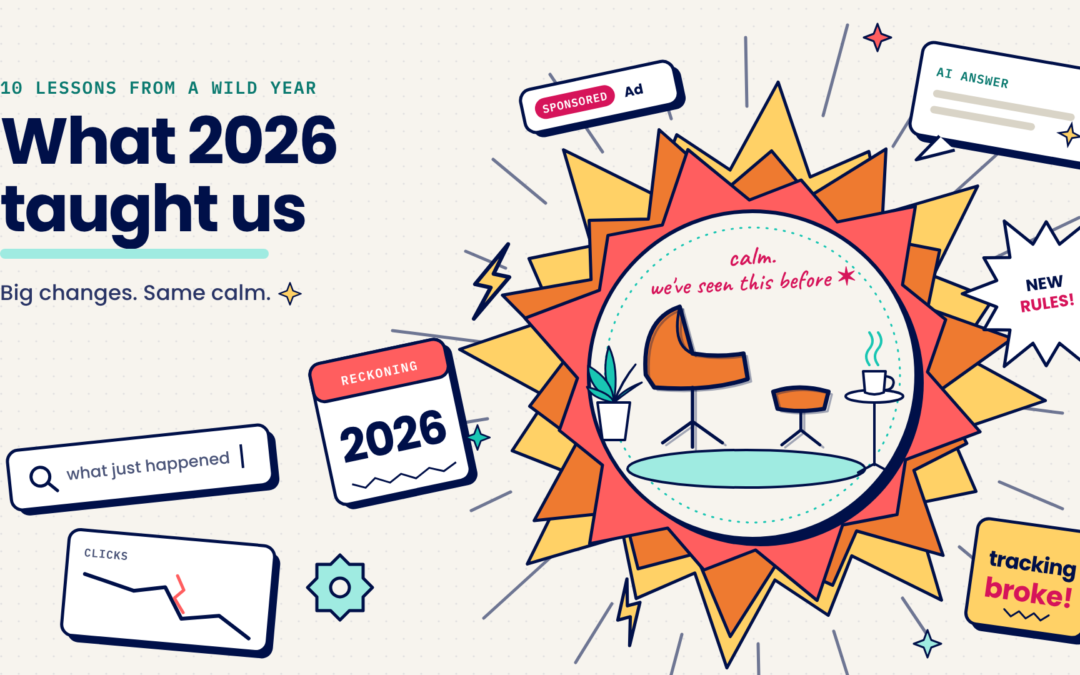
Ten things 2026 taught us
1. Start where the money already is
When AI search took off, a lot of brands tried to show up for everything at once. That’s a fast way to spend a lot and learn very little. Our best AI search work this year started inside Google Ads and the CRM. Those two sources show which questions lead to real customers, so those questions came first.
What we do now: every AI search plan starts with the searches that already make you money. The fun experiments come second.
2. AI answers cite sources you don’t own
We spent a lot of time this year looking at what AI Overviews and ChatGPT cite. The answer surprised some clients: YouTube videos, review sites, “best of” lists and comparison pages show up again and again. Your own website is only part of the story.
What we do now: we map where AI pulls its answers from, then work on the places you’re missing, on your site and off it. More on that in what AI Overviews actually cite.
3. Ads moved into the answers, and most accounts weren’t ready
Google now shows ads above, below and inside AI Overviews and in AI Mode. ChatGPT shows sponsored placements too. The catch: campaigns built only on exact match, thin product feeds and landing pages that skip the follow-up questions mostly sit on the sidelines.
What we do now: a readiness check comes before any new AI placement gets budget. Fix the plumbing, then turn up the volume. Here’s how we approach AI search advertising.
4. Tell Smart Bidding what a good lead looks like
More than once this year we found Smart Bidding doing exactly what it was told, which was the problem. It was chasing form fills and page views instead of customers. For one behavioral health client, tracing every lead from first click into Salesforce helped bring cost per inquiry down 16%.
What we do now: we connect ad platforms to real outcomes before we hand automation more money. Here’s how to tell if Smart Bidding is chasing the wrong goal.
5. Test automation with a budget cap and a finish line
AI Max, broad match and Performance Max can find customers you’d never reach with keywords alone. They can also spend money on things you’d never approve.
What we do now: every automation test gets a slice of budget, brand exclusions, a clear success measure and an end date. If lead quality holds, it scales. If not, we say so. Our AI Max breakdown and Performance Max competitor playbook share what we’ve learned.
6. Clicks got harder, so revenue became the scoreboard
AI Overviews answer a lot of questions right on the results page, so some traffic charts went sideways this year. That didn’t always mean bad news. One children’s products brand grew organic revenue 56% year over year, even as search traffic shifted. Fewer visits, better visits.
What we do now: we report on leads and revenue first, and traffic second. We shared our thinking in AI Overviews and Google CTR: our 2027 projections.
7. Tracking breaks quietly
The most expensive problems we found this year didn’t announce themselves. Consent banners that loaded after the tags they were supposed to control. Duplicate conversion tags. Google Ads and GA4 reporting different numbers, with no one sure which to trust.
What we do now: we check conversion tracking before any campaign launches, and again whenever a site or consent tool changes. If you’ve ever wondered about the gap, read why Google Ads and GA4 never agree. For healthcare clients, privacy comes first: how to measure healthcare marketing without leaking patient data.
8. AI referral traffic is real, but messy
Visits from ChatGPT, Perplexity and Gemini grew for a lot of our clients. They also bounced around month to month in ways that had nothing to do with anything we changed.
What we do now: we track AI referrals, watch the trend over a few months, and don’t celebrate or panic over a single week. More in AI referral traffic is unpredictable.
9. Prove it at the bottom of the funnel first
When a well-known UK outdoor apparel brand wanted to grow in the US, we resisted the urge to start with big awareness campaigns. We started with shoppers who were ready to buy, proved results fast, then built from there. Online orders grew 402%.
What we do now: quick, measurable wins first. They earn the trust and the budget for everything else.
10. One team, one plan, one set of numbers
The pattern we saw most this year: results jump when SEO, paid search, social, analytics and AI search work as one program. A cybersecurity platform up against competitors with two to four times its budget tripled qualified leads and cut cost per lead 37% in six months, with paid and organic search run together.
What we do now: the same senior people read your rankings, your ad data and your AI visibility, so nothing gets lost between specialists. You can see more client results here.
What we’re taking into 2027
If I had to sum up the year in one line, it would be this: the tools got smarter, so the basics got more important. Clean tracking, clear goals and good content are what the AI tools learn from. Feed them well and they do great work. Feed them junk and they find creative new ways to waste your budget. We’ll keep testing new tactics on our own site before we recommend them to you, and we’ll keep telling you what we think, including when something is hype.
Got a puzzle of your own? We’d love to hear about it. Let’s talk, or meet the team behind these lessons.