Every advertiser wanted to sink its teeth into Google’s newest, AI-first campaign type – Ai Max, but it appears that it’s not built for every industry. And it definitely wasn’t built for every marketing outcome.
In May of 2025, Google Ads released AI Max. Now that we’re past the stage of bold predictions and Google Ad reps and gurus telling you how great it is without evidence, let’s take a deep dive into the good, bad and the ugly of AI Max. Here’s what we’ve found, seen and learned after one year.
The Advantages of AI Max
New ad platform product releases create buzz and push platforms to prioritize their newest product over predecessors. This is especially true for Google (YouTube, Performance Max, Demand Gen, creative tools, the list goes on). With reps pushing AI Max on advertisers, there had to be defined reasons and benefits of opting in. The original promise was that the Google Ads algorithm would prioritize AI Max, provide lower cost metrics (CPA, CPC, CPM), and upticks in performance metrics (CTR and Impression Share).
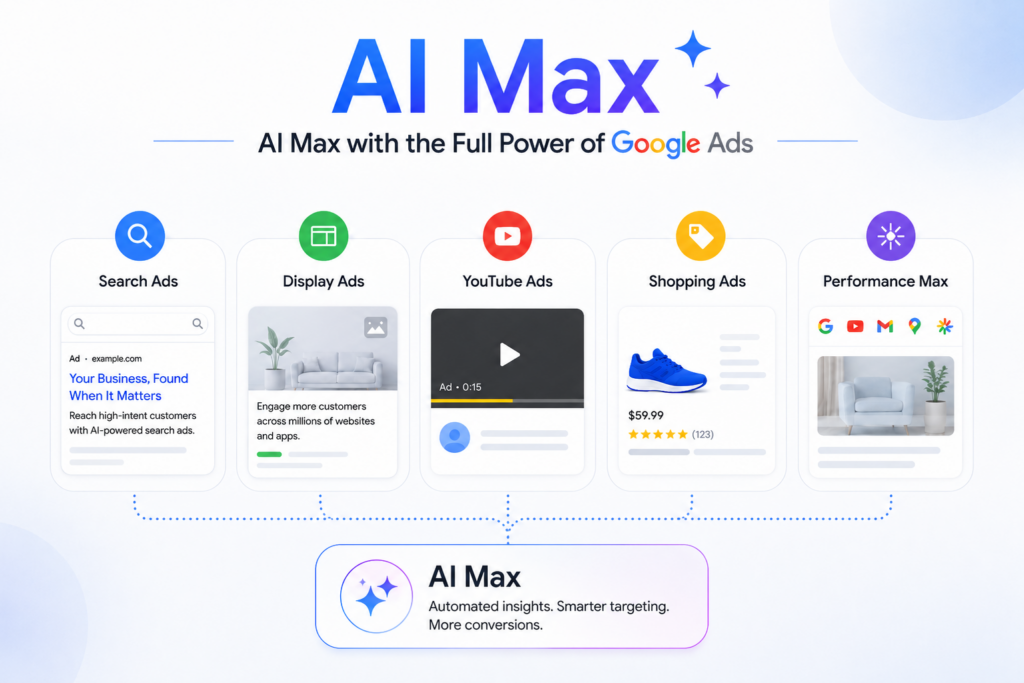
This campaign type is built largely for “non-advertisers”, similar to Smart Campaigns or “Ads Express”. People who prioritize automated search campaigns and don’t feel they need insights, data and customization allowed by traditional search campaigns. Intelligent search term matching, automated text customization, and final URL expansion lay the foundations for a low touch “set and forget” campaign.
To the novice user, these seem like overall positives. Not having to develop a keyword strategy, not having to use real data to inform ad refreshes, and not having to decide which pages will perform best when a user clicks onto your page all seem like great features for an all-in-one approach. By enabling AI Max, you are empowering your brand to expand into auctions that may have been missed out on before due to manually created keyword lists and targets.
The real proof is in the details though. To reap the benefits and not throw dollars into the abyss, guardrails must be implemented. Having a dedicated Google rep with the ability to provide forecasting on true business outcomes alongside suggestions and best practices is important in laying the foundation of AI Max. CRM integration, tiered lead scoring, value based tracking, SQR vigilance, and a strict negative keyword strategy are also essential in moving towards successful business outcomes.
The inner workings of AI Max cater more towards industries with loose brand guidelines, faster purchasing decisions and industries that don’t need to build trust before converting a customer.
The Downfalls of AI Max
Quality.
The most important word to any growth or performance marketer.
Since the release of AI Max, quality has seen its most drastic fall off that we’ve seen since the beginning of Google Ads.
The lowest standard for quality match type over the past 10 years has been broad match. Google’s AI Max has taken this a step further. With no more control over keywords in any sense other than negation, AI Max’s “intelligent search term matching” is closer to “ultimate broad match” than it is to any prior keyword match type. New searches are falling out of industry, outside of related queries, outside of even language, and into unrelated product categories and even complete opposite and unrelated searches.
Google campaigns as of late have been costing more, producing less and decreasing in overall quality across leads and search placements. If you’re reading this, you’ve probably seen this in your own accounts. Campaigns have decreased the amount of control on inputs for advertisers while simultaneously decreasing the quality of outputs that the platforms provide. This is especially true for AI Max.
Across our pilot AI Max campaigns, we have seen that some industries have better outcomes than others. Campaigns that are built to convert in one click without any consideration are best suited for AI Max. On the other hand, industries like pharma and healthcare find the opposite to be true. When dealing with compliance, campaigns that have the ability to go off rail like AI Max prove to be inadequate to meet marketing goals. And while vanity metrics have improved drastically, CRM data has shown that for the most part, AI Max has driven unqualified leads.
Automatic ad copy updates have also proven to be a pain, especially in regulated industries. The AI Max platform generates new ad copy automatically based on what inputs it receives from search results and what it sees as “best practice” in advertising. These results have proven to be low quality and therefore are decreasing the quality of the copy shown in future ads. Automatic updates also negate the ability to incorporate brand voice, brand messaging and brand strategy for the end consumer. And in some cases, breaking compliance and risking actual business outcomes.
The AI Max Verdict
Industry dependent, AI Max could be a solid addition to an already fully strategized and built out ads account. If fed the correct information from CRM data alongside a tight analytics integration, it could work to convert a consumer who has already worked down the funnel and is ready to make a purchase decision. In industries with quick turnarounds and low CAC, AI Max could also prove to be useful.
Regulated industries should be careful and make sure that their marketing team or agency is proficient in understanding how AI Max works before piloting the campaign. Making sure that strategy and outcomes are clearly defined and communicated is most important when moving into a less controllable campaign type.
Overall, AI Max seems to be an unfinished product. With quality lagging behind other campaign types, it is best to formulate and test campaigns in controlled settings like Search and Performance Max before activating AI Max. While impressions and clicks may skyrocket, it does not mean that it is truly impacting business outcomes. The right thing to do for any campaign is choosing quality (in proven outcomes) vs. vanity metrics.
Some agencies may push towards AI Max as it improves their relationship with Google. Great agencies will push back at Google until these campaigns prove their worth and show that actual business outcomes are being improved. As a 2026 Premier Partner of Google Ads, Simple Search continues to push back and test what really works when building out a comprehensive marketing strategy. See what Simple Search could do for you.
Work With Us!