Your product launch checklist probably includes paid ads, email, social media, and maybe a little PR. But what happens when your customers ask ChatGPT what they should buy?
You’ve spent months developing a new product. The packaging looks great. Your website is almost ready. Your launch campaign is coming together. And then someone asks: “Are we going to show up when people ask ChatGPT about products like ours?”
Good question. Shoppers still use Google, but they’re also asking ChatGPT, Gemini, Perplexity and other AI tools for recommendations and comparisons. Instead of “best baby travel products,” they might ask for a lightweight stroller for a family that flies often and has a $500 budget. So what can you realistically accomplish if your product launches in 30 days? Quite a bit, provided you focus on the right things.
First, Can You Get a New Product Into AI Search in 30 Days?
You can improve your product’s readiness for AI search in a month. You cannot guarantee that AI platforms will discover, cite or recommend it by launch day. Some experiences retrieve live web information; others use different indexes and product data, and update on different schedules.
Don’t chase a secret trick for getting into ChatGPT. Make product information easy to find, easy to understand and supported by credible information beyond your own website.
Four Weeks Before Launch: Get Your Product Pages Ready
Think about what someone needs to know before recommending your product: what it does, who it’s for, what makes it different, price, ingredients or specifications, and when it might not be the right fit. Does your product page answer those questions?
For a skincare launch, explain the ingredients, intended skin types, usage, size, price and differences from other products. Include substantiated testing results and certifications when available. Specific information beats vague claims about a “revolutionary formula.”
Don’t Forget the Technical Stuff
Check that pages can be crawled and indexed when public, important information appears in readable page content, and Product structured data accurately describes price, availability, brand and identifiers. Keep product feeds accurate and check crawler restrictions. If the launch is confidential, prepare everything in staging rather than publishing early.
Three Weeks Before Launch: Find Out What Customers Are Asking
Traditional keyword research still matters, but AI prompts are often longer and more specific. A baby carrier shopper might ask which carriers are easiest to put on alone, suitable for newborns or comfortable while traveling.
Use customer service questions, sales conversations, competitor reviews, product research and Google Search Console to identify real concerns. Then improve product descriptions, comparison pages and FAQs. You don’t need 50 blog posts; you need a few excellent answers.
What We’ve Seen With a Real CPG Client
Simple Search Marketing has worked with a leading children’s products brand for seven years. Major retailers also sell its products, creating competition for the brand’s own website. The strategy included improving product and collection pages, answering parents’ questions, technical SEO and relevant third-party mentions and links. In September 2026 organic revenue increased 56% year over year, organic purchases up 39%, and more than 1,300 new Google AI Overview rankings in a month. These are results from sustained work, not a 30-day launch campaign,but show why product information and useful content matter.
Read the CPG ecommerce case study: https://simplesearch.
Two Weeks Before Launch: Build Awareness Beyond Your Website
A product page is only one source of information, and you are the seller. Relevant publications, credible reviewers, retail partners and legitimate creator partnerships can help people evaluate your product independently.
A detailed review from a respected publication is often more useful than dozens of generic press releases. Prioritize relevance and credibility. Be wary of anyone promising guaranteed AI recommendations in exchange for purchased mentions or links.
One Week Before Launch: Test How AI Tools Understand Your Brand
Ask ChatGPT, Gemini, Perplexity and Google’s AI search experiences questions prospective buyers might ask. Test the problem and category, not just a product name nobody knows yet. Note which brands appear, what sources are referenced and which product details are mentioned.
A single answer is not a reliable benchmark: responses vary by prompt, platform and time. Establish a repeatable set of prompts and monitor them consistently. If an unreleased product does not appear, that is unsurprising.
Launch Week: Make Sure Everything Works
Confirm pages are live and indexable, inventory and prices are correct, checkout works on mobile, policies are easy to find, product feeds are updated and conversion tracking is tested. Paid campaigns should land on the right pages.
AI-assisted shopping is evolving, but clear product data and a working checkout are good investments regardless of how someone discovers you.
What Should You Measure After Launch?
A customer might see your brand in an AI answer, search for it later and buy without analytics ever connecting those events. Measure several signals together: search impressions and clicks; AI mentions and citation accuracy; identifiable AI referrals; branded search trends; qualified visits; and, most importantly, sales.
In the CPG case study, organic sessions were down year over year, partly because a cookie-consent change affected measurement, while organic revenue and purchases rose. Traffic alone never tells the whole story.
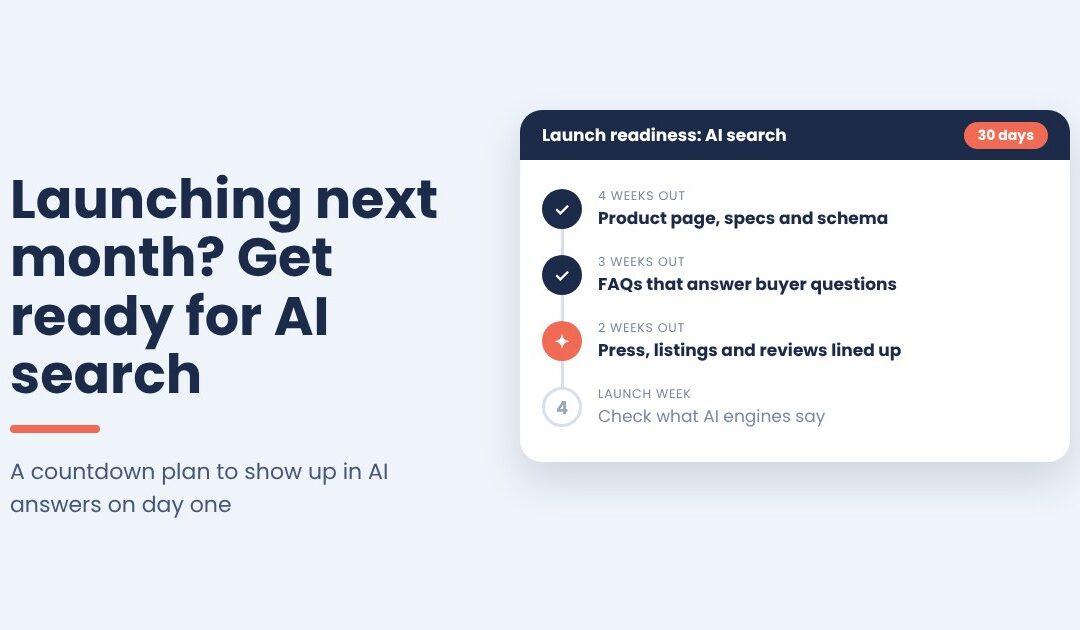
Your 30-Day AI Search Product Launch Checklist
| Timing | Priority |
| Week 1 | Product pages, technical SEO, structured data and feeds |
| Week 2 | Customer questions, comparison content and FAQs |
| Week 3 | Credible third-party coverage, reviewers and retail partners |
| Week 4 | AI visibility tests, tracking and launch readiness |
| Launch day | Live, indexable, accurate pages and functioning checkout |
| Next 30–90 days | Monitor visibility, mentions, referrals and sales; improve content |
Do You Need a Separate AI Search Strategy?
Yes and no. Account for AI-powered discovery, but don’t abandon traditional SEO. Helpful content, accurate product details, technical accessibility, credible coverage and an easy buying experience still matter. What changes is how conversational discovery and AI mentions are monitored.
If you have only 30 days, start now. You can make meaningful improvements without promising a recommendation by launch day.
Launching Something New? We’d Love to Help.
At Simple Search Marketing, we connect traditional SEO, AI search optimization, paid media and analytics so brands can be discovered by people most likely to buy. If you have a launch coming up, let’s discuss what is realistic before launch day and how to build visibility afterward.