Ads now appear inside AI answers on Google, Microsoft and OpenAI. Each platform decides where ads show and how much you can see about them. Google and Microsoft run AI ads through campaigns you already have. OpenAI uses its own Ads Manager and gives the least visibility. Note: Details change quickly, so check current help documentation before you publish.
Where AI ads show on each platform
Google (AI Overviews and AI Mode)
Google ads can appear above, below or within AI Overviews, and inside AI Mode answers, in sections labeled “Sponsored.” Ads above and below an AI Overview can run in all 200+ countries and territories where AI Overviews are available. Ads inside AI Overviews and AI Mode run in English in the US, Australia, Canada, India, Kenya, Malaysia, New Zealand, Nigeria, Pakistan, the Philippines and Singapore.
On October 28, 2026, Google launched multiturn ads in the US, so sponsored listings can appear during follow-up questions in an AI Mode thread. It plans to bring AI Mode ads to Brazil, Mexico and the UK in Q4 2026.
You can’t buy these placements directly or opt out of them. Existing Search, Shopping and Performance Max campaigns are eligible automatically, using the same auction and bidding as other Search ads, and AI Max can widen the queries you match.
Note that search campaigns that aren’t opted into AI Max can still show ads in AI Overviews and AI Mode. Exact and phrase match keywords qualify when the search shows direct commercial intent, and broad match can also reach broader, exploratory questions. In practice, if your account runs mostly exact and phrase match, you will only reach the shorter, buyer-intent questions UNLESS you opt in to AI Max.
Microsoft (Copilot and Bing AI Overviews)
- Copilot: Ads appear beneath the answer in an “ad block,” where Copilot explains why it included the ad (Microsoft calls this “ad voice”). They run in Copilot Search on Bing, the Copilot sidebar in Bing and Edge, and the Copilot app.
- Bing AI Overviews: On November 19, 2026, Microsoft confirmed ads can appear next to AI Overviews on Bing in all markets except China.
Microsoft picks ads using the whole conversation in a session, not only the latest message. There’s no separate campaign setup: ads run through Performance Max, AI Max and other campaigns you already use. Eligible campaigns are opted in to Copilot automatically. Formats reported as eligible include multimedia ads, product ads (Shopping and Performance Max), search ads, and vertical ads such as property promotion and tours and activities. Confirm the current list in Microsoft’s help center.
OpenAI (ChatGPT)
ChatGPT shows one ad unit below a response when there’s a relevant match, labeled and separate from the answer. Ads only appear for Free and Go users, never in Temporary Chats, and not for users OpenAI identifies or predicts are under 18. OpenAI also blocks ads near sensitive conversations, including mental and personal health topics.
During the initial test, most ads come from consumer categories: lifestyle and household goods, local services, travel and experiences, and digital products or education. Some health and financial advertisers can now qualify under strict eligibility rules. Matching works differently here. OpenAI matches ads to queries its own system writes from conversations. You supply “context hints,” which OpenAI says are not targeting rules or delivery instructions and cannot enforce geographic limits, schedules or exclusions. Qualifying advertisers can add negative phrases for narrow brand-policy needs.
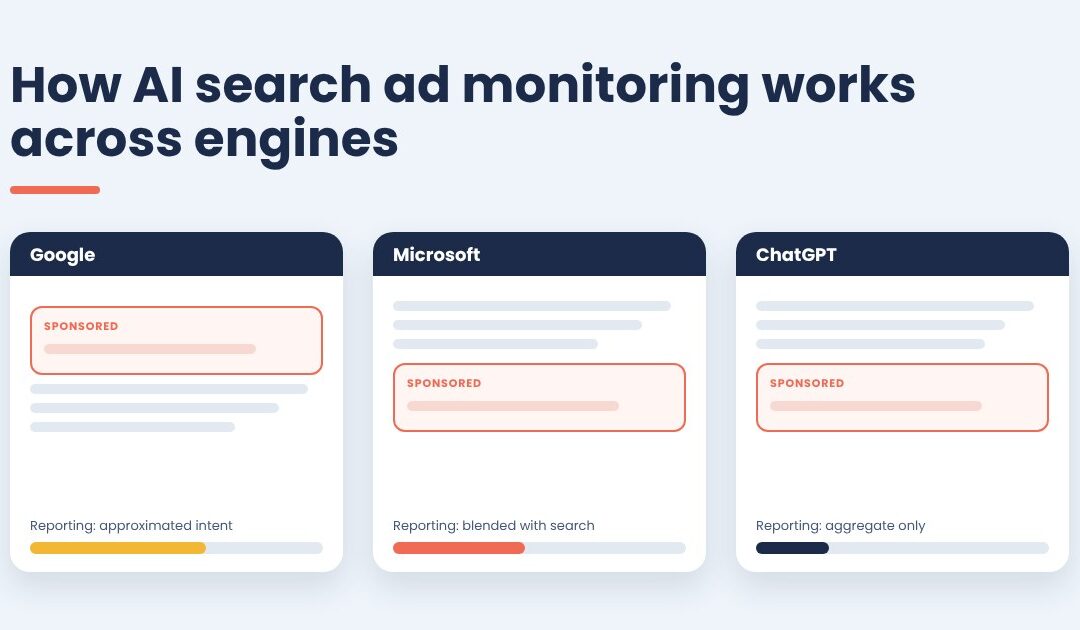
How AI ad monitoring differs
OpenAI. Ads Manager reports impressions, clicks, spend, CTR, average CPC, average CPM and conversions. OpenAI’s Vijaye Raji told Adweek that prompt-level or intent-level reports aren’t planned, and advertisers can’t see the queries behind their ads. Conversions can take 24 to 48 hours to appear. You can choose a 7-, 14- or 30-day click window, plus an optional one-day view-through window. View-through conversions are reported separately and don’t count toward CPA or bidding.
Google. For AI Mode, AI Overviews, Lens and autocomplete, the search terms report shows “the best approximation of the user’s intent,” not the exact query. As with “normal” search campaigns, some low-volume terms are also hidden for privacy, though their clicks still count in campaign totals. Industry reporting says there’s no separate view of AI Overview or AI Mode impressions, so that traffic is blended into regular Search results.
Microsoft. Third-party guides say Copilot results aren’t broken out separately in reporting. Microsoft hasn’t confirmed this, so check your account. Because eligible campaigns are opted in automatically, a clean test with Copilot switched off may not be possible.
| Microsoft | OpenAI | ||
|---|---|---|---|
| Where ads show | Above, below or within AI Overviews; inside AI Mode, including follow-ups (US) | Below Copilot answers; next to Bing AI Overviews | Below ChatGPT answers |
| How you get in | Search, Shopping, PMax, AI Max | PMax, AI Max, Shopping, eligible search and vertical ads | Ads Manager with context hints |
| Query visibility | Approximated intent | Not confirmed for Copilot | None |
| Separate AI reporting | No | Reportedly no | Yes, aggregate only |
| Opt out | No | No (auto opt-in for eligible campaigns) | Not applicable (separate platform) |
| Conversion lag | A few hours, typically | Not documented | 24 to 48 hours |
What else is worth knowing re: AI ads and Organic visibility
- ChatGPT reaches fewer people than its user count suggests. About 85% of ChatGPT’s estimated 94.7 million US users are eligible to see ads, but fewer than 20% see one on a given day, according to an OpenAI spokesperson (eMarketer).
- Measurement is what’s holding ChatGPT budgets back. Seven months after launch, agencies still describe ChatGPT ads as test budgets, citing late conversions and no demographic or prompt data (Digiday).
- Read Microsoft’s 21% stat carefully. Microsoft cites a 21% increase in purchases after a Copilot interaction when promoting Bing AI Overview ads. That figure comes from Copilot data in Edge from December 2024, not from AI Overview ads (Big Data University).
- Organic AI visibility is now measurable in Search Console. Google added reports that isolate site impressions from AI Overviews, AI Mode and Discover’s AI features. That gives you an organic baseline to compare paid results against.
- Perplexity left the ad business. Perplexity tested sponsored follow-up questions from late 2024 and confirmed in February 2026 that it’s no longer pursuing advertising. Visibility there depends entirely on organic citations.
- Amazon Rufus is the next AI ad surface to watch. Rufus “sponsored prompts” are cheap but tiny so far. One seller saw 88 clicks from them versus 500,000 from all Amazon ads, at roughly 31 cents a click. Brands are also studying the prompts to learn what shoppers ask.
How to build your own AI ads measurement
- Tag every landing page with UTM parameters, using a distinct campaign name per platform. For ChatGPT, also capture OpenAI’s click reference (oppref) and pass it back through the Conversions API.
- Use GA4 to catch AI-referred traffic that platform reports miss. People often see an ad and come back later through a branded search.
- Compare platform-reported conversions with GA4 and your CRM. Compare ChatGPT on click-through conversions only, since view-through numbers aren’t comparable to other channels.
- Watch Google Search Console’s AI visibility reports and branded query trends after campaigns start.
- Mark launch dates for new AI placements, like Bing AI Overviews ads (November 19) or AI Mode ads reaching the UK, so you can read later changes in clicks or conversion rate against them.
- Review weekly, and give ChatGPT conversions 48 hours to settle before judging a day’s results.
We are also very actively iterating on the “best way” to track Organic AI performance and whether 3rd party AI Visibility Tools are worth it. Reach out if you’d like to explore AI in Search!