If you want to be the go-to business where your stores or services are located, you’ve probably thought about investing in both SEO and Google Ads. Maybe you’re already doing both. But here’s the question I’d ask: are they working together? It’s worth asking, especially if you’re paying one agency for organic rankings and another for paid search.
There’s nothing wrong with that setup. Plenty of businesses get great results with more than one agency. But over the years, we’ve seen how much opportunity slips through the cracks when the people running SEO and PPC never talk to each other.
I “grew up” professionally in a small agency that did web design/development, google ads, SEO, and the early days of social media. I was taught by my former boss Steve A. how to think about and run Organic & Paid Search together. Most clients we had used both channels and strategists ran both SEO AND Paid Search for the same client. It just made sense.
First, what does it mean to dominate a city on Google?
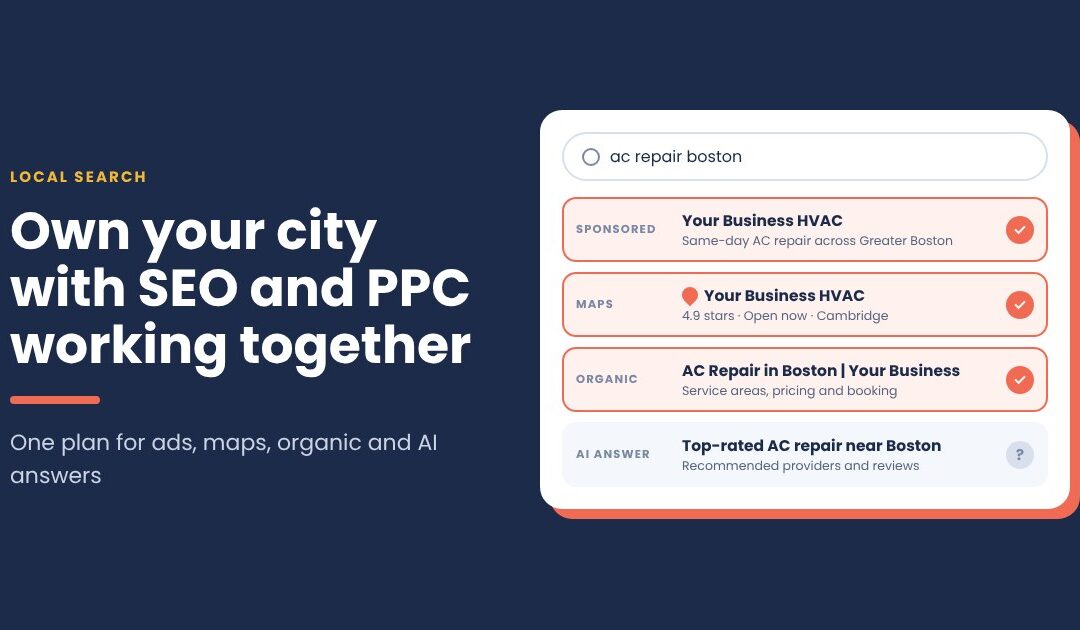
Say you own an HVAC company in Boston and you want to show up when someone searches “AC repair Boston,” “emergency furnace repair near me” or “best HVAC company in Cambridge.” Google doesn’t give you one shot at that search. Depending on what someone types, they might see sponsored ads, Google Maps listings, regular organic results and, more and more often, AI-generated answers.
You could rank beautifully for one search and be nowhere for the next. You might own the map results near your office and barely exist on the other side of town. That Google Maps pin means a lot 🙂 That’s why we don’t think of local search as “get the website to rank higher.” The better question is: is your business showing up when and where your future customers are looking? Answering that means looking at paid and organic search together.
Your Google Ads account is sitting on valuable SEO information
This is one of MY favorite reasons to run SEO and PPC together. Google Ads tells you which searches produce leads. Traffic is nice, but this goes further: it shows which searches bring in people who call, fill out a form or become customers. That’s gold when you’re deciding where to focus SEO.
Imagine you’re a roofing company in Denver. Your Google Ads data shows that “hail damage roof inspection” brings in qualified leads week after week. Meanwhile, your SEO team has spent months chasing the much broader “Denver roofing company.” Both are likely worth going after, but knowing which services bring in business (vs. vanity clicks) gives you a much smarter starting point for what content to write and which pages to improve.
It works the other way, too. Google Search Console might show thousands of impressions for a service you offer, but you’re ranking too low to get many clicks. That’s a great keyword to test in paid search while you build up organic visibility. When two separate agencies manage these channels, that information doesn’t always make it from one team to the other. And that’s a shame, because you’re already paying to collect it.
Sometimes you need leads now. Sometimes you’re playing the long game.
I always try to be honest with clients about this: SEO takes time. If you’re a newer business up against established companies in a big city, you’re probably not jumping to the top of organic results overnight. Paid search lets you compete for visibility while SEO gains traction.
Say you’re opening a second location for your dental practice. You need patients now, not six months from now. Google Ads can reach people searching for a dentist in your new neighborhood, as long as the targeting, budget and landing pages are set up right. In a parallel path, SEO can build up your location page, Google Business Profile, local citations and the other pieces that support visibility for years.
We’ve seen this work. For one national services company, paid search and SEO working together delivered 4.2x more booked jobs from paid search and 461 new page-one rankings for “services in [city]” searches while they expanded into five new states. As organic performance improves, you can decide whether to adjust your paid budget. Notice I didn’t say turn off your ads once you rank. That’s a common assumption, and it isn’t always right.
Targeting a city is different from understanding it
Local search gets complicated quickly. NAP and all that. Katie Conroy is the OG expert in local search by the way. Take Boston again. A business says it wants to target Boston. Does that include Cambridge? Somerville? Brookline? Newton? And what if you’re a service business that drives to customers instead of one people visit? These details shape both SEO and paid search, in different ways.
In local SEO, Google says Maps results are based mainly on relevance, distance and prominence. Your physical location and service areas matter, but so do your reviews and how well-known your business is.
In Google Ads, you have much more direct control over geography. But watch your settings. By default, Google can show your ads to people who’ve shown interest in your target area, not only people who are there. For a local service business, that can mean paying for clicks from people who will never be your customers.
An agency managing both channels should understand these differences. You might find you already have strong organic visibility near your office but very little in surrounding towns. Paid search can reach those areas while SEO figures out where organic growth is realistic.
You don’t need more traffic. You need more of the right traffic.
We love a good traffic increase as much as anyone. But if website visits are up 40% and the phone isn’t ringing, something’s off. This is where running SEO and PPC together makes a big difference. Instead of looking at organic sessions and paid conversions in separate reports, you can see how search is contributing to growth:
- Are you getting more qualified leads from your target city?
- Which services are driving those leads?
- Are people calling, filling out forms or booking appointments?
- Most important, are those leads becoming paying customers?
For local businesses, connecting Google Ads and GA4 with your CRM is where the real answers are. You might find that one campaign brings in lots of cheap leads that rarely become customers, while a service page brings in fewer inquiries that turn into much bigger jobs. (And if your Google Ads and GA4 numbers don’t match, here’s why that happens.)
Your website shouldn’t have an SEO personality and a PPC personality
We run into this a lot. A business has well-optimized SEO pages full of helpful information, but its Google Ads send people to completely different landing pages with different messaging.
Sometimes that’s on purpose. PPC landing pages often need a more focused path to conversion than a content page does. But sometimes the two teams built their strategies without ever comparing notes. The result is mixed messages, duplicate work and missed chances to improve the site.
Your SEO team might notice visitors looking for pricing, service areas or availability. Your PPC team might learn through testing that one headline or call to action gets far more inquiries.
Wouldn’t it be nice if those insights were shared? They should be.
An integrated search strategy doesn’t mean every page has to serve SEO and PPC equally. It means the people working on those pages know what the other team has learned.
What about Google Maps and AI search?
This is where it gets interesting. For many local businesses, Google Maps is one of the most important places to show up. And more people are using AI search to research local providers, compare businesses and ask for recommendations. That makes accurate business information, helpful website content and a strong reputation key parts of your search strategy. (Our AI search optimization guide covers what tends to get businesses cited.)
But let’s be clear about what each channel can and can’t do. Paying for Google Ads won’t improve your Google Maps rankings. Running PPC doesn’t make ChatGPT more likely to recommend you. These systems work differently……although lots of us still have questions……
The benefit of an integrated strategy isn’t that one channel magically boosts another. It’s that your team has a more complete picture of how people find and evaluate your business, so you can make smarter decisions about where to spend your time and money. If AI visibility is a priority, that’s what our AEO consulting focuses on.
Is it always better to hire one agency for SEO and PPC?
No. And I’d be suspicious of any agency that told you otherwise. There are excellent SEO specialists and excellent PPC specialists who work together beautifully, even at different companies. Having two agencies isn’t the problem. Having two agencies that act like they work for two different businesses is.
If your SEO agency only cares about rankings and your PPC agency only cares about cost per click, who’s looking at how you win customers overall? Who decides which services deserve more investment? Who’s checking whether you’re gaining ground in the city you want to own? And is everyone using the same definition of a qualified lead?
You need clear answers to those questions whether you work with one agency or five. (If you’re thinking about making a change, our guide to switching digital marketing agencies walks through how to do it without losing momentum.)
What to ask an agency before you hire them
If you’re looking for one partner to handle local SEO and paid search together, start with these questions. (We have a longer list in 7 questions to ask before hiring a search marketing agency.)
- How do your SEO and PPC teams share data? Not an occasional forwarded report. You want to hear how they regularly use what one channel learns to make decisions in the other.
- How would you approach winning one specific city? A good agency will want to understand your service area, competitors, customers and most profitable services before recommending anything.
- How do you measure success? If the answer is only rankings, clicks and impressions, keep asking. Those numbers are useful, but they don’t tell you whether your business is growing.
- Who’s doing the work? Offering both SEO and PPC doesn’t mean an agency is strong at both. Ask who will manage your account, how the teams collaborate and what experience they have with businesses like yours.
- How will you decide where our budget goes? The right answer isn’t “50% SEO, 50% PPC” before they understand your business. Your budget should reflect your goals, your competition and the opportunities in each channel.
One city. One search strategy. A lot of opportunity.
If your goal is to be the business everyone in your city knows, your SEO and paid search shouldn’t live in separate silos. The people running your marketing should understand the same customers, chase the same goals and learn from the same data. Sometimes that means one agency managing everything. Sometimes it means getting your current agencies to collaborate better. Either way, the goal is the same: show up when the right people are searching, give them a great reason to choose you, and turn that visibility into growth.
Looking for one team for local SEO and paid search?
At Simple Search Marketing, we manage SEO and paid search together, as two different disciplines working toward the same goal. Our senior team looks at the search landscape, your competition and your data to find the best opportunities for your business.
And if you’re trying to become the go-to provider in one city, that’s exactly the kind of challenge we love digging into. Let’s talk about how to get more of your future customers finding you.