Your audience has a new best friend (and it talks back)
Here’s something we’ve noticed after years of staring at spreadsheets of search data: people are much more honest with ChatGPT than they ever were with a Google search bar. In Google, someone types “directions to Traverse City.” In ChatGPT, she might type “what are the most fun towns to stop for an overnight visit somewhere in between the Hudson Valley and Traverse City with pet friendly hotels and a walkable downtown” (me + my life revolving around Juni….also, I wish she could talk back).
Same person. Same need. Wildly different amount of information.
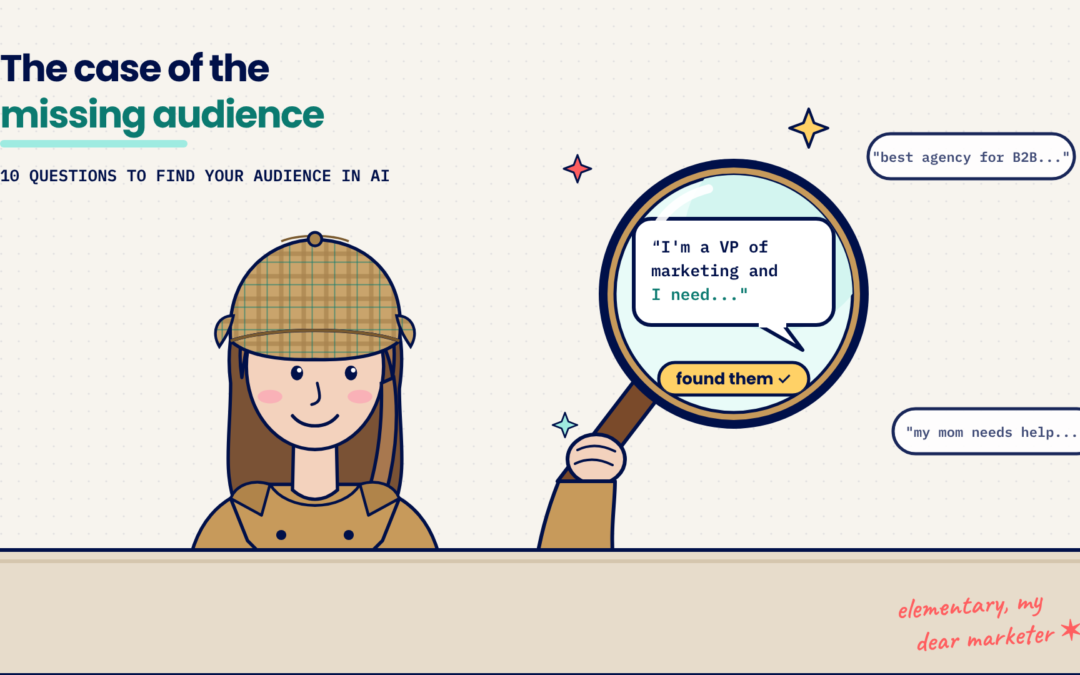
That’s great news for marketers, because AI search is basically a giant open window into what your audience is worried about. The catch? You can’t see their prompts the way you can see keywords. So you have to get a little clever about finding your audience in AI. We’ve been philosophizing over this for a long time and it dovetails really nicely with our existing client kickoff conversions, so here are the 10 questions we ask every client, plus where to find the answers.
The 10 questions
1. What do customers ask right before they call you?
Your sales team already knows your audience’s AI prompts. They just call them “questions from prospects.” The things people ask on a first call (“Do you work with companies our size?” “How long does this take?” “Is this HIPAA compliant?”) are the same things they asked ChatGPT ten minutes earlier. Check out sales call notes, chat transcripts, contact form fields, and the inbox of whoever answers the phone. We’ve been enjoying Hubspot’s Breeze Assistant to crawl through conversations & find treasure.
2. Which search terms turn into customers?
Paid search is the most honest audience research tool ever built, because people tell you exactly what they want, word for word. Pull the search terms that led to real leads or sales. Clicks are nice. Customers are nicer. Those words show you the exact language your buyers use when they’re ready. Trawl the search terms report in Google Ads and Microsoft Ads, matched to closed deals in your CRM. PS – growing up in the industry doing SEO/PPC the whole time, I naturally gravitate to the Google Ads keyword tool. Anyone else?
3. What would they type into ChatGPT that they’d never type into Google?
AI prompts are longer, chattier and a lot more personal. People share their budget, their timeline, their boss’s opinion and their biggest fear. Try writing five prompts the way a real customer would, full sentences and all, then run them yourself. Try getting real specific. Start each prompt with “I’m a…” (“I’m a VP of marketing at a 200-person software company and…”) and see how much the answer changes. It’s so funny to see these queries in GSC, amirite?
4. Who’s asking on someone else’s behalf?
This one surprises people. A lot of AI research is done by helpers. Adult children researching senior living for a parent. An executive assistant shortlisting agencies. A parent comparing children’s products. A junior marketer building a vendor list for a CMO. If your content only talks to the final decision maker, you’re missing the person doing the homework.
5. What follow-up questions does AI ask behind the scenes?
When someone asks an AI tool a question, it often runs a bunch of smaller searches in the background (the nerdy term is “query fan-out”). Ask “best B2B SEO agency” and the AI may also look up pricing models, reviews, case studies and how to vet an agency. So your audience gets answers to the next five questions too, often before they ever see your website. Make sure you’ve answered them.
6. Who does AI recommend instead of you, and why?
Ask the AI engines the questions your customers ask, and write down who shows up. Then ask the fun follow-up: “Why did you recommend them?” The answer usually points to something specific, like reviews, a comparison page, a clear pricing explanation, or a mention on a site the AI trusts. That’s your to-do list.
7. What does AI get wrong about you?
We’ve seen AI say a client offers services they stopped offering years ago, list the wrong headquarters, and confuse them with a company that has a similar name. Your audience believes these answers. Ask ChatGPT, Gemini and Perplexity “What is [your company] known for?” and “Who is [your company] a good fit for?” If the answer describes the wrong audience, your website probably isn’t saying who you serve clearly enough
8. Where does your audience compare notes and vent?
AI engines love Reddit, YouTube, review sites and industry forums, because that’s where real people talk. Spend an hour reading threads in your space. You’ll find the exact phrases people use, the objections they have, and the competitors they’re comparing.
9. Once AI shortlists you, what makes someone pick you?
AI can get you on the list, but a human still makes the choice. People tend to start broad and narrow down: when Charity Navigator piloted an AI search tool, about 80% of searches asked about a cause (Stanford Social Innovation Review, October 2026). So when someone finally lands on your site, what tips the scale? Proof, people and clarity. Case studies with real numbers. Bios of the humans doing the work. A page that says in one sentence who you help. Where to look: ask your last five new clients why they chose you. Then put their answers on your website.
Your audience didn’t change. The way they ask did.
The people you’ve always served are still out there with the same worries, budgets and deadlines. They’re just asking a chatbot first now, and they’re telling it a lot more.
The good news? Most of these answers are already sitting in your CRM, your ad account and your sales team’s heads. You don’t need a fancy tool to start. You need a spreadsheet, a few curious hours, and a willingness to ask ChatGPT some questions.
If you’d like a hand, our AEO consulting team starts every engagement with a free AI visibility snapshot. We’ll show you how the AI engines describe your brand, who they recommend instead, and which questions your audience is asking that you haven’t answered yet.